Digital Health Governance in Iran: A Situational Analysis and Future Scenarios
Keywords:
Digital Health Governance, Situational Analysis, Scenario PlanningAbstract
Background: Despite extensive technological investments, the transition to digital health governance in developing systems is often trapped in institutional inertia. Existing literature largely suffers from a retrospective bias, overlooking how emerging legal mandates reshape future trajectories. This study critically examines the contested field of digital health governance in Iran, specifically focusing on the structural tensions introduces by the 7th National Development Plan (2024–2029).
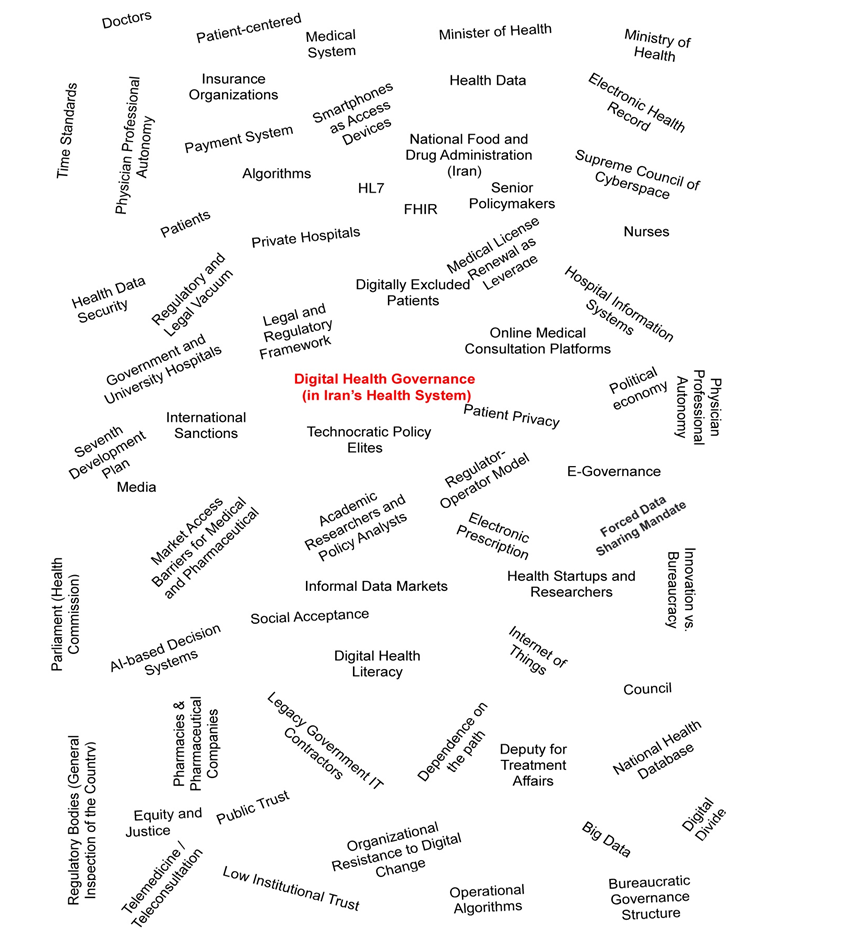
Methods: Adopting a Hybrid Prospective Qualitative Design, this research integrates Adele Clarke’s Situational Analysis with a Scenario Planning framework. Empirical data were drawn from 18 in-depth interviews with elite stakeholders and a critical analysis of key policy documents. Based on the identified governance logics and data regimes, a matrix was constructed to map plausible futures for the 2035 horizon.
Results: The analysis reveals a governance deadlock where the state’s drive for data centralization—codified through the Regulator-Operator model—clashes with the needs of an innovation ecosystem. Four divergent future paths are identified: 1.Digital Stagnation (a path-dependent outcome of current bureaucratic silos), 2.The Digital Panopticon (efficient technical integration under strict authoritarian surveillance), 3.Innovation Islands (fragmented private success without national scaling), and 4.The Dynamic Ecosystem (participatory governance treating data as a public good). Findings suggest that current legal mandates are actively steering the system toward the first two scenarios.
Conclusion: The transition to a sustainable digital health ecosystem is not merely a technical challenge but a political one. Avoiding the trap of a Digital Panopticon requires a fundamental institutional reconfiguration: shifting from the sovereign asset framing of health data toward a participatory governance model that balances state stewardship with ecosystem agency.
Downloads
References
Abbasi, F., Mahmoudi, J., & Aghajantabar, M. (2019). Review of research trend in electronic governance. Future Study Management, 30(116), 15-30.
Abdolhosseinzadeh, M., Sanaei, M., & Zolfaghari Zadeh, M. M. (2017). Conceptualizing open government data policy and explaining its benefits across various policy domains. Strategic Studies of Public Policy (Globalization Strategic Studies), 7(22), 55-74. https://sid.ir/paper/229937/fa
Andrews, M., Pritchett, L., & Woolcock, M. (2013). Escaping capability traps through problem driven iterative adaptation (PDIA). World Development, 51, 234-244. https://doi.org/10.1016/j.worlddev.2013.05.011
Bagherzadeh Khodashahri, R., Delmohammad Azadeh, M., & Bagherzadeh Khodashahri, R. (2023). Designing a model of good governance for promoting administrative health in the tax system. Tax Research Journal, 31(59), 106-128. http://taxjournal.ir/article-1-2324-fa.html
Beikzad, J., & Jalilinejad, Q. (2021). Pathology of digital governance in e-government. Elites of Science and Engineering, 6(6), 17-33. https://sid.ir/paper/968222/fa
Beikzad, J., & Zare Dizaj, A. (2018). A review of concepts and theories of good organizational governance. Proceedings of the National Conference on Management, Economics and Accounting,
Bowker, G. C., & Star, S. L. (1999). Sorting things out: Classification and its consequences. MIT Press.
Cairns, G., & Wright, G. (2017). Scenario Thinking: Preparing Your Organization for the Future in an Unpredictable World. Palgrave Macmillan Ltd. https://doi.org/10.1007/978-3-319-49067-0
Carnicero, J., & Serra, P. (2020). Governance for digital health: The art of health systems transformation. https://doi.org/10.18235/0002661
Clarke, A. E. (2005). Situational analysis: Grounded theory after the postmodern turn. Sage Publications. https://doi.org/10.4135/978141298583
Clarke, A. E. (2009). From grounded theory to situational analysis: What’s new? Why? How? In Developing grounded theory: The second generation (pp. 194-233). Left Coast Press.
Clarke, A. E. (2021). From grounded theory to situational analysis: What’s new? Why? How? In Developing grounded theory: The second generation (Revisited ed.) (pp. 223-266). Routledge.
Clarke, A. E., Friese, C., & Washburn, R. S. (2018). Situational analysis: Grounded theory after the postmodern turn (Vol. 2nd ed.). Sage Publications.
Cordella, A., & Bonina, C. M. (2012). A public value perspective for ICT-enabled public sector reforms. Government Information Quarterly, 29(4), 512-520. https://doi.org/10.1016/j.giq.2012.03.004
Dunleavy, P., & Margetts, H. (2013). Digital era governance (Vol. 2nd ed.). Oxford University Press.
Dunleavy, P., Margetts, H., Bastow, S., & Tinkler, J. (2006). New public management is dead—Long live digital-era governance. Journal of Public Administration Research and Theory, 16(3), 467-494. https://doi.org/10.1093/jopart/mui057
Frenk, J., Gómez-Dantés, O., & Knaul, F. M. (2014). The health systems agenda: Prospects for the diagonal approach. In The handbook of global health policy (pp. 425-439). Wiley-Blackwell. https://doi.org/10.1002/9781118509623.ch23
Ghalibaf, M. B., Ahmadi, A., Kiani, M. A., Zarei, B., & Pourezzat, A. A. (2025). The governance patterns of the health system in developed countries of the world: A systematic review. CIMEXUS, 20(1), 77-99. https://doi.org/https://cimexus.umich.mx/index.php/cimexus/article/view/577
Ghalibaf, M. B., Ahmadi, S. A., Zarei, B., Pour Ezzat, A. A., & Kiani, M. A. (2024). Designing a semi-centralized governance model for Iran’s health system. Social Business, 1(2), 160-177.
Gotsadze, G., Zoidze, A., Gabunia, T., & Chin, B. (2024). Advancing governance for digital transformation in health. BMJ Global Health, 9(10), e015589. https://doi.org/10.1136/bmjgh-2024-015589
Jalali Khanabadi, T., Alvani, S. M., Vaezzi, R., & Ghorbani Zadeh, V. (2020). Designing a network governance model in the national health system. Journal of the Iranian Management Sciences Association, 15(58), 1-30.
Janowski, T. (2015). Digital government evolution: From transformation to contextualization. Government Information Quarterly, 32(3), 221-236. https://doi.org/10.1016/j.giq.2015.07.001
Janssen, M., Chun, S. A., & Gil-Garcia, J. R. (2009). Building the next generation of digital government infrastructures. Government Information Quarterly, 26(2), 233-237. https://doi.org/10.1016/j.giq.2008.12.006
Janssen, M., & van der Voort, H. (2016). Adaptive governance: Towards a stable, accountable and responsive government. Government Information Quarterly, 33(1), 1-5. https://doi.org/10.1016/j.giq.2015.11.001
Kazemi, M., Dehghanpour-Farashah, A., & Dehghanpour-Farashah, A. (2025). Smart public governance scenarios driven by digital transformation: A foresight study on government human capital transformation. Business Intelligence Management Studies. https://doi.org/10.22054/ims.2025.89007.2698
Kianian, T., Lotfi, M., Zamanzadeh, V., Rezayan, A., Hazrati, M., & Pakpour, V. (2022). Exploring barriers to the development of home health Care in Iran: a qualitative study. Home Health Care Management & Practice, 34(2), 83-91. https://doi.org/10.1177/10848223211038510
Kickbusch, I., & Gleicher, D. (2012). Governance for health in the 21st century. World Health Organization Regional Office for Europe. https://iris.who.int/handle/10665/326429
Kohnke, O. (2017). It’s not just about technology: The people side of digitization. In Shaping the digital enterprise (pp. 69-91). Springer. https://doi.org/10.1007/978-3-319-40967-2_3
Lincoln, Y. S., & Guba, E. G. (1985). Naturalistic inquiry. Sage Publications.
Luna-Reyes, L. F., & Gil-Garcia, J. R. (2014). Digital government transformation and internet portals. Government Information Quarterly, 31(4), 545-555. https://doi.org/10.1016/j.giq.2014.08.001
Mittelstadt, B. D., Allo, P., Taddeo, M., Wachter, S., & Floridi, L. (2016). The ethics of algorithms: Mapping the debate. Big Data & Society, 3(2), 1-21. https://doi.org/10.1177/2053951716679679
Mohammadi, H., Alvani, S. M., Memarzadeh Tehrani, G., & Hamidi, N. (2019). Assessing the status of influential components in the legal dimension of Iran’s administrative system. Strategic and Macro Policies Quarterly, 6(22), 7-22.
Nabovati, A., Shami Zanjani, M., & Gholipour, A. (2019). Conceptualizing the digital workplace in organizations. Administrative Transformation Journal, 6(61), 34-59.
Nambisan, S., Wright, M., & Feldman, M. (2019). The digital transformation of innovation and entrepreneurship. Research Policy, 48(8), 103773. https://doi.org/10.1016/j.respol.2019.03.018
North, D. C. (1990). Institutions, institutional change and economic performance. Cambridge University Press.
O’Reilly, T. (2011). Government as a platform. Innovations: Technology, Governance, Globalization, 6(1), 13-40. https://doi.org/10.1162/INOV_a_00056
Organisation for Economic, C.-o., & Development. (2015). Health data governance: Privacy, monitoring and research. OECD Publishing.
Organisation for Economic, C.-o., & Development. (2016). Digital government strategies for transforming public services in the welfare areas. OECD Publishing.
Organisation for Economic, C.-o., & Development. (2022). Health data governance for the digital age: Implementing the OECD recommendation on health data governance. OECD Publishing.
Ostrom, E. (2010). Beyond markets and states: Polycentric governance of complex economic systems. American Economic Review, 100(3), 641-672. https://doi.org/10.1257/aer.100.3.641
Patton, M. Q. (2015). Qualitative research and evaluation methods: Integrating theory and practice (Vol. 4th ed.). Sage Publications.
Pierson, P. (2000). Increasing returns, path dependence, and the study of politics. American Political Science Review, 94(2), 251-267. https://doi.org/10.2307/2586011
Pollitt, C., & Bouckaert, G. (2017). Public management reform: A comparative analysis into the age of austerity (Vol. 4th ed.). Oxford University Press.
Prior, L. (2008). Repositioning documents in social research. Sociology, 42(5), 821-836. https://doi.org/10.1177/0038038508094564
Salarianzadeh, M. H., & Latifi Jelyseh, S. (2020). Challenges of governance structure in the Ministry of Health based on the network structure model. Hakim Health Systems Research Journal, 23(2), 189-200.
Schwartz, P. (1996). The art of the long view: Planning for the future in an uncertain world. Currency Doubleday.
Shamsi Davood, M., Mohammadian Saravi, M., Mohammadzadeh Khalil, A., & Ashrafi, A. (2025). Presenting a good governance model in Iran’s health system. Journal of Arak University of Medical Sciences, 28(2), 121-132.
Taghaddosi, F. (2020). Scenarios for the future of digital governance. Farda Futures Studies Center.
World Health, O. (2021). Ethics and Governance of Artificial Intelligence for Health. WHO.
World Health, O. (2023). Global report on health systems: Digital transformation for universal health coverage. WHO.
Wright, G., Bradfield, R., & Cairns, G. (2013). Does the intuitive logics method – and its recent enhancements – produce “effective” scenarios? Technological Forecasting and Social Change, 80(4), 631-642. https://doi.org/10.1016/j.techfore.2012.09.003
Zuboff, S. (2019). The age of surveillance capitalism: The fight for a human future at the new frontier of power. PublicAffairs.

Downloads
Published
Issue
Section
License
Copyright (c) 2025 Ahad Rezayan, Dr. Ali Asghar Pourezzat, Asal Neshat Kafash (Author)

This work is licensed under a Creative Commons Attribution-NonCommercial 4.0 International License.